Presentation Day

Presentation Day IDDS 2015

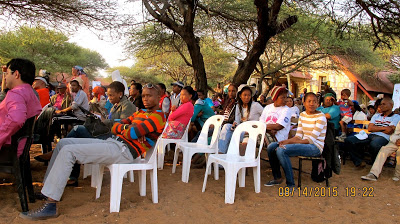
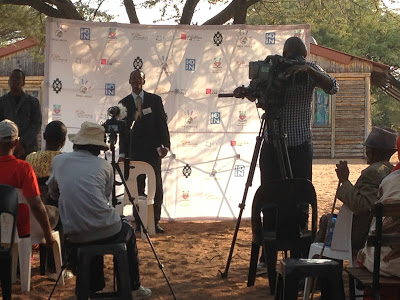
We got a great showing! We kept having to pull out more benches from the church to seat the people coming. I hope our audience found our prototypes interesting – as a participant, I was impressed with what we were able to do in just two weeks, especially considering that our prototypes were constructed in just four days. Internally, and I know I was not alone in this feeling, I wish we had more time to iterate through the feedback and innovation process. Not everyone’s first tries will feel successful – however, and I know this from my experiences from hackathons as well – we are also not good judges of the value of what we create. We will have baggage of intentions and expectations, and our audience can judge our first drafts based on merits alone, and often it’s much better than what we think. Some community members expressed concern about the what next? You all leave and then what? I know that a parallel process to answer this is underway, so that the local community should have enough interest to express this concern rings of some success to me.

Written by: Claudine Chen

 IDDS 2015 Closing Ceremony

Working

Working

It’s make-it-work time. I went to Ghanzi to scope out our material options. On the list was sheet metal, rod, hardened steel blades. These things exist, but not necessarily in the dimensions desired. There are three hardware stores and they all carry similar stock.

We also stock up on groceries, and it is in the supermarket where we encounter the glory of the openness of where we are. I was told upon arrival in Botswana that people say hello even to strangers. Since then I’ve been saying “Dumela” to people I make eye contact with and I register a warm feeling when they respond with a smile. Now in the market, a complete stranger asks me what happened to my neck (I have chronic excema), and Anirudh is being told that he as beautiful hair, hair like a woman’s. I find this open directness absolutely refreshing. What is on my neck is not some shameful thing that you can’t ask about – ask if you want to know! And the backwards compliment to Anirudh’s hair has an air of playful joking, and brings a laugh to my lips anyway.

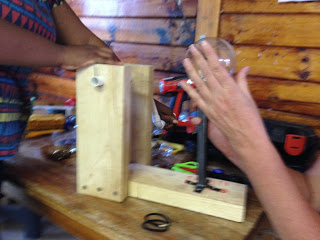
We all depend on Aaron’s welding. Did anyone document his hard work in progress? The fodder chopper is an impressive thing, sturdy as all-get-out. Our own weeder drum, made out of thick steel is also an impressive feat of brute force – the bit of steel is cut with an angle grinder, and Lulu pounded the steel held in a makeshift wooden vise made out of 2x4s and c-clamps. it may not be a thing of beauty, but it is a thing.

Written by: Claudine Chen

Camp Fires & Star Gazing

A wonderful thing about having IDDS in the middle of the Kalahari Desert is that every night we get to witness a brilliant panorama of stars. With no air pollution or streetlights in sight, constellations are bountiful. The other day a family staying within the D’Kar community even invited us to use their telescope for a 2-hour star gazing session. We were able to see Saturn and its rings! We finished the night with an intellectual conversation and lecture on the history of constellations.

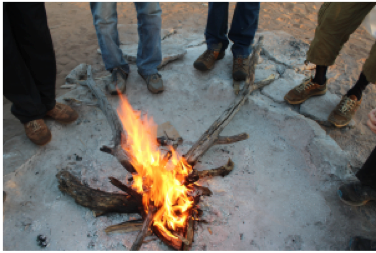
If we are not busy start-gazing in the evenings, we are eagerly sharing stories and laughing at the campfire. Being in the middle of the desert means that it is absolutely freezing in the evenings…fortunately, this encourages us to all congregate in one place, close to the fire. Thus far we have watched the process of charcoal making, heard traditional San stories, practiced West African dance, and even played board games together all while sitting around the camp fire. It is here that friendships are created and solidified.

IDDS Camp Fire

Build-Its!!

Build Its 1

Build Its 2

Build Its 3

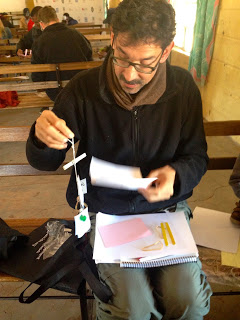
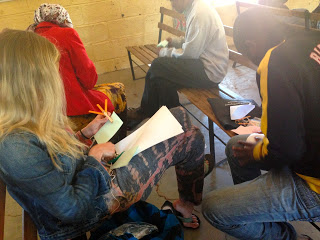
The first week of the summit was focused on helping participants grasp the concepts of design thinking, sketch modeling, and prototyping. In order to encourage teamwork and a mindset of continuous inquisitiveness and problem solving, we split the participants into groups to perform a Build-It activity. Each individual in each team was given a random bag of supplies and asked to create something useful to him or her using only the materials in the bag. After twenty minutes the model was given to another person to be improved upon. This continued until each model had been tweeked and improved upon by each member of the team. Final products of each group were then presented to everyone for inspiration and to get the creative juices flowing for the real prototyping!

Building with the San People by Tamanna Islam Urmi

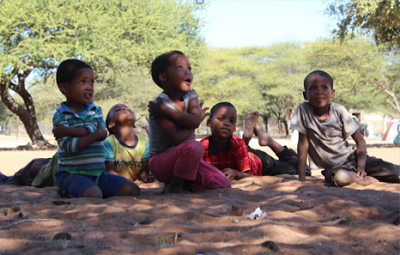
San Children - D'Kar, Botswana

After a 9 hour journey in the bus of University of Botswana, we landed to the training center of D’Kar and got welcomed by a group of local participants, IDDS organizers and wood fire in a circular fenced area. Little did I know that this circular area around is going to a defining feature of my experiences in the next two weeks.

The only light around us were the light inside the bus, a few dimming lights afar in the wood-houses where we will reside for the summit and the dark orange fire. I quickly shook hand with the welcoming group and glanced upwards. The huge sky with no interruptions but a few thorny twigs is holding up covering as much as the eyes can see. The pitch black sky is filled with millions of sparkling stars and a cloudy white band has spanned across the middle of the sky! It took me a few seconds to process that it’s the Milky Way, so clearly drawn out, and what we can see is one hand of the spiral we live in. The band goes from one side to the horizon, or as far down we can see, to the other side touching horizon. I quickly put my luggage in my triple room and ran outside to look at the sky while feeling the warmth of the fire.

The Morning FIre
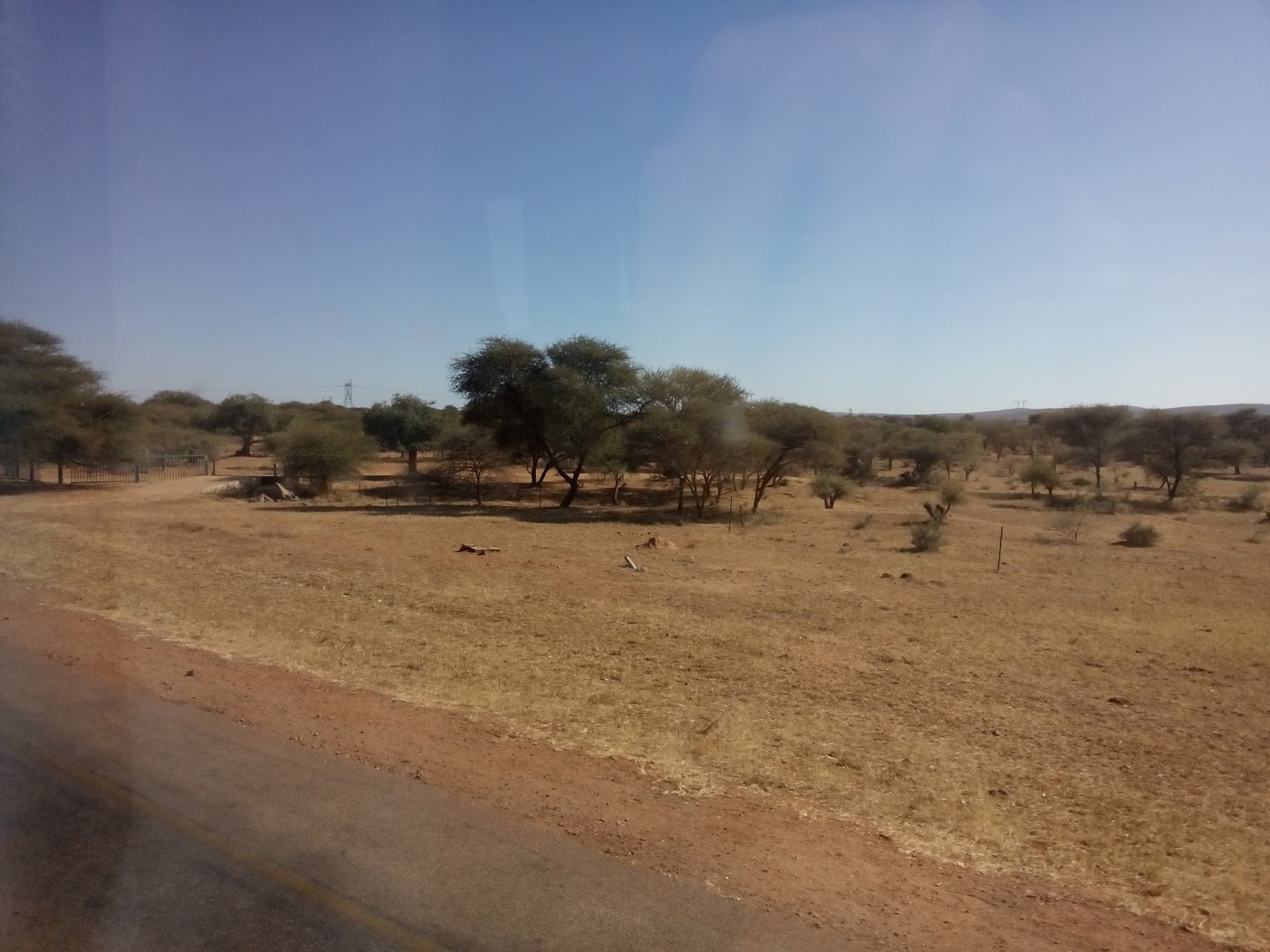
Mornings started with a gathering around the fire again. The next two weeks we will immerse in the community, learn to design with people, roll on the Kalahari sand in the light of setting sun for treating our backs and end the day sitting by the fire with an amazing and amazingly diverse group of people. The place we are in is a small village beside the Kalahari Desert. The sand here has a reddish tint to it, water is scarce but in the training center we get 24 hours supply of water from a pump somewhere around. It’s winter here at this time with very cold nights and mildly cold days. Plants around has low-hanging thorny branches with green leaves that looked grayish green from a distance.

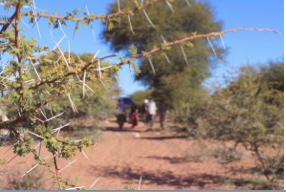
thorns

The top of the land has a loose layer of sand about ten to fifteen centimeter deep with a harder and denser layer below it. Lying down on the sand therefore leads the loose layer on top to form the shape around the back. That at the back along with the warm winter sunlight from the top is beyond soothing. The first time I saw the moon was the first night. It was quite strange to see the moon in a shape never seen before. The moon phases of Southern and Northern hemisphere is flipped and near the equator moon is more tilted from the vertical. Check this link to get visual clarification.

Along with the nature there were people and ideas that replenished my treasure of experiences. In the first week we learned and accustomed ourselves with all the tools to build our project, such as, design cycle, information gathering techniques, process of bouncing off ideas of teammates to improve designs, working with tools in workshop, designing constraints, brainstorming ideas and so on. There were multiple hands on sessions to get our hands dirty in designing. The second week we stepped into the community with all the tools we need to dive deeper into the problems our respective groups are assigned with to gather necessary information, brainstorm ideas for designing a device as a solution, sketch modeling and then eventually building a functional prototype.

In one of the build-it sessions of the first week, the international participants learned to build things from the locals. Some craftsmanship locals are good at and need to do at a regular basis are building bow and arrows and starting fire in the woods. I with five other people hammered wire-end and shaped it into an arrowhead and attached it to a thin stick to make an arrow. We then practiced hitting a target with the arrow. A group went into the woods to learn to start a fire. An exclusive form of art in D’kar is to make jewelry out of the eggshells of ostriches. The shells are broken into small pieces, drilled through, sanded to smooth out the sharp edges to give a circular finish and used to make jewelry. A lot of us who spend most of our times in cities with little connection to building things for day-to-day living enjoyed learning the local craftsmanship. Besides that the mutual teaching and learning helped us become better friends with the locals. Locals of D’Kar speak the language Naro that has phonetic features that I hadn’t heard earlier. There are many types of clicking sounds, including dental, alveolar and palatal clicks. (Not that I understand what is what). The San people struck me as very very creative and expressive people who never ran out of energy to communicate thoughts in the most beautiful manner. As a participant accurately mentioned in a presentation, “Each person in the community is a magnificent artist”.

Then there was food. Food consisted of a lot of meat and maize preparations. We were served with food that is a fusion of Botswana local culinary practices with others making the food taste different from what people ate but quite good nevertheless. The landscape around is not the most agriculture friendly so a huge portion of the nutrition came from meat. For the starch pap, samp (base of a meal made with maize) and rice were common. It was at times difficult for the vegetarians but the cooks tried to accommodate the different dietary needs with vegetarian options in every meal and Halal chicken for Muslims who practiced Halal eating. And there were sodas and juices, a wide variety of them. We got to know that with the scarcity of water and a liking towards sweet drinks, people in this region has grew a great fondness for sweet beverages that come in Aluminum cans.

People of D’Kar, their language, food and art blew my mind but there were more. There were people from twelve other countries. It was like a buffet of experiences and knowledge.
Two weeks were too short to get into depth with the different cultural and intellectual exposures I could get.  But I learned about the puberty rituals of Botswana, the Zambian dance and the Brazilian dance, the Bharatnatyam poses for male and female in storytelling dances, facts about stars and universe, stories of traveling alone in mountains, stories of being the first one to go to college, stories of struggles and stories of failed attempts, art forms of dark room imaging, deceptively realistic water color portrait from live models, ideologies around religions beliefs, political standpoints, and lastly, the knowledge of so many doors I was unaware about that I can now go on to explore.

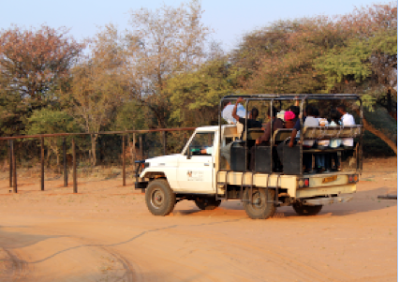
truck

“Arrival” – Reflections by Claudine Chen

IDDS 2015 at D'Kar, Botswana

Arrival 2

By ten we are on the road. Even though we are spaced out, the conversation flows easily. What are you reading, what was your Peace Corps experience like, what are you doing now – it’s like sunrise conversations from college but with people with twice the life experience. Beep beep beeeep beep beeeeeep! Ah, a herd of cows. Beep beep beep beep beeeeeep! Oh, donkeys this time. Beeeep beep beep beep beeep! Were those ostriches?! At lunch we get our first taste of some local starches. Pap is like thick white polenta, and samp is like exploded corn kernels.

The terrain is sometimes red, sometimes grey. The sun is going down below the horizon with a blaze of orange, and still we are on the bus. We keep crawling forward in the dark, until the black is pierced with the orange warm glow of a roaring fire. We are welcomed off the bus with smiling faces and handshakes all around. We feed, meet our roommates, we sit by the fire, we sleep.

Our facilities are 5 star luxus, especially considering we are in the Kalahari desert. Power in the rooms for charging devices, a cellular tower just next door, hot water in the bathroom, and comfortable beds with two sets of blankets for the cold nights, there is little more we need for comfort in this modern age.

The next morning, we finally can see where we have landed. Outside the dorms there is fire circle. Across there is the kitchen and church. Thorny trees with spiral rattling seed pods threaten to catch your hair if you are not careful.

“Getting There” – Reflections by Participant Claudine Chen

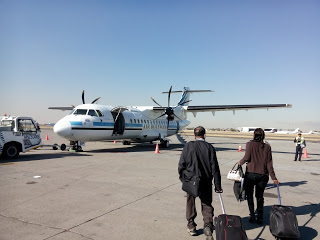
Made it, the Friday night bus to Berlin-Tegel airport. I’ve had a busy week, and I have not mentally prepared for the IDDS that I’ve been looking forward to for months. It feels strange, yet it is a release, to suddenly drop everything happening in my daily life for a completely new experience. There is little time to process what is about to come as I pack the day of my flight, and I as I hop my way towards Gaborone, I make each step closer with the awareness of an automaton. On the last leg to Gaborone, we are herded into a bus, and one by one we pass huge planes about to jet off to distant locations like Dubai or London. Nestled between two giants is our cute twin propeller, and I can’t help but smile. My rowmate joins me soon after I settle into my window seat, and we discover we are both going to D’Kar! Suddenly it clicks, we are going into the Kalahari desert, and the journey has begun.

 plane

Packing List!

Hello IDDS Dkar participants. As the summit approaches we want to make sure that you have a comprehensive list of things for you to bring to the two weeks of co-creation that lies ahead of us. If you like, use this list as a checklist when you’re packing to come to Botswana.

PLEASE REMEMBER TO BRING:

❏ Passport and visa

Photocopies of all important documents such as:

❏ Passport/identification

❏ IDDS invitation letter

❏ Health Insurance information

❏ Flight itinerary

❏ Towels, and pillow (optional). We will provide sheets and a blanket

❏ Registration Fees and/or IDDS Financial Assistance Letter if applies)

❏ Your creative IDDS spirit! 🙂

ITEMS YOU MUST PACK:

Here are some items that you should bring with you in addition to your regular packing items.

Clothes

❏ The month of August is the end of the winter season in Botswana. The night temperatures can be very freezing but it warms up rapidly during the day. It is also very windy during the day so a handkerchief or a bandana will be ideal for wiping off the dirt or dust. A warm sweater and long sleeve shirts (for avoiding bugs) are highly recommended

❏ Bring light colored clothes. This will also help you avoiding bugs

❏ Tshirts, shorts and trousers

❏ A sun hat or any other item that can help you protect from the sun.

❏ Mostly clothes that are easy to wash and that will hold up well in the workshops and dusty communities

❏ One set of nice clothes for making presentations at our important open events.

❏ Please drop in any cultural outfit (if any) for our cultural night

❏ Remember to bring enough underwear too. They always come in handy!

❏ Although it will be hot during the day, we recommend you bring closed toes shoes. These are ideal when working with tools
Women’s Wear : Both in the village and at the venue women are welcome to wear any outfit freely. Feel free to come with whatever is most comfortable for you given the warm weather

conditions and the chilly weather in the evenings. Keep in mind that light colors and long sleeve/trousers will help you avoiding bug bites. Those who would want to visit the church should bring skirts or dresses to wear to church.
Men’s Wear : Same case for men; you are welcome to wear any outfit. Light colors and long sleeve/ trousers are ideal to will help you avoiding bug bites. For church services men are advice to wear long trousers.

Shoes

❏ Closed toe shoes for working in the workshops

❏ Sandals or Flip Flops for using inside the hostel and to shower
Toiletries

Insect repellent. We highly recommend you to bring lots of repellent. There is currently an upsurge of a mosquito but they do not cause malaria. Repellent and long sleeve, light colored clothes will be of great help in avoiding the mosquito

❏ Bath towels for use in the communities

The following items are optional, but recommended:

❏ Soap, shampoo, toothpaste, dental floss

❏ Hand sanitizer or wet wipes (for cleaning hands when necessary)

❏ Small mirror (useful if you wear contacts)

❏ Nail Cutter

❏ Cottonbuds
Bedding

❏ In general, we recommend you bring a mosquito net if you have access to one. We highly recommend it for those who are prone to mosquito bites.

Health items

❏ Basic first aid (we will provide first aid kits but be sure to bring any medication you need (for allergies, special conditions, headaches, upsetting stomach, bandages, antibacterial cream and anti-itch creams for heat rash or insect bite, vitamins, etc.). Medication for most common diseases are easily bought in Ghanzi.
Others

❏ A refillable water bottle. We will have water dispensers throughout the venue.

❏ The spirit of the IDDS is in sharing and learning. At some points in the summit participants will share some of the skills they are good at. If you would like to share your skill (weaving, origami, jugglery, dance) please bring the materials or music you will need to share it.
NICE TO PACK ITEMS

Work items

❏ Cell phone (It is very helpful to bring your cell phone. Also make sure it is unlocked to accept foreign SIM cards).

❏ Laptop (We provide some computers for people to share at IDDS, feel free to bring your own if you wish)

❏ If you are bringing any electronics, don’t forget your chargers (converter/adapter plugs) and spare batteries. European and American plug adapters are easy to find in Botswana.
Useful items for travel

❏ Small flashlight with spare batteries (useful for reading at night or getting around on campus)

❏ Watch/alarm clock

❏ Handkerchief/bandana (good for wiping off dust, sweat, etc)

❏ Swimwear, as you never know where adventure will take you.
Entertainment (all optional)

❏ Camera with spare batteries/charger and extra memory card or a transfer cable

❏ Books, art supplies, small music instruments

❏ Items from your country to share with others:

❏ Traditional clothing, games, music

❏ Photographs of your home/family/country/work

❏ Tools and local technologies unique to your region

❏ Small gifts (but we will help teams make gifts to thank the village hosts and mentors so you don’t have to worry)
Items we provide

Dishes/silverware
Other Packing tips:

  • Pack light but not too light that you leave out the most essential things you will need to make your stay worthwhile. It is best to use backpacks/luggage that is easy to carry.
  • We will be sharing snacks during our camp fires. Feel free to bring something typical that you are able to pack safely and would love to share with other participants.
  • Clothesline and pins (helpful for drying wet clothes outside)
  • Headphones/earplugs (good for long trips on noisy roads or if you are a light sleeper)
  • Money belt or small pack to discreetly carry money and valuables
  • Dictionary/phrasebook
  • Tools (we will provide tools but if you want to bring more specialized tools that you feel comfortable working with, feel free to bring that)


(*) Last but not least. At IDDS we like to share and get to know you better, despite of the short time. This is why throughout the summit, we invite participants to share about their interesting work, passion and awesome projects back home. And because we really want you to make most of the time you will have in Botswana, we recommend you to bring your presentations ready, to share a little about you with us.

Part 5 – People-driven economic development in Botswana: innovation, entrepreneurial spirit and traditional knowledge

dkar

Between August 3rd and 16th 2015 the small San settlement of D’kar on the edge of the Kalahari Desert in western Botswana will be the venue of a unique and pioneering event: the International Development Design Summit D’kar 2015. In collaboration with the University of Botswana’s Department of Industrial Engineering, IDDS D’kar aims at connecting and training the San people along with selected participants from around Botswana and the globe in the basics of user-based technology design and business development process as they work together in diverse teams to co-create technologies that address particular local development challenges. The San communities in Botswana are some of the most creative people in Botswana with an immensely rich heritage of local knowledge and adaptive practices. However, they are also amongst the poorest and most marginalized people of the country.

For the Government of Botswana a big potential for economic development lies in the recognition and appreciation of the vast amount of (traditional) knowledge and practices of its people. It is the role of the state to encourage and reward entrepreneurship, innovation, technological advancement, scientific exploration and groundbreaking ideas that will contribute to further economic growth and social welfare of the country. IDDS D’kar hopes to inspire government, civil society and every citizen of Botswana with tangible dreams and concrete results in the form of innovative prototypes and ventures that improve people’s lives.

Botswana has since independence seen great economic growth but relatively little economic development. The general social welfare of Botswana is not matching the economic status of the country, the economy needs to be diversified in order for the economic development to be sustainable and citizens need to be encouraged and empowered to show more initiative and play a larger role in their own economic development and that of the nation as a whole.

The Government of Botswana has invested hope, energy and resources in the future of the country: the youth. Education and skills development have led to a more educated youth than ever before. However, the levels of unemployment amongst this large group of educated youth are currently high. This is not only a consequence of recent economic downturn; it could also indicate poor quality of education and poor preparation of graduates by the education system to be flexible, innovative and to show initiative and an entrepreneurial spirit. If the youth of the country can be inspired and stimulated to develop these attributes, there is a great potential for much needed growth of citizen economic empowerment and private sector expansion. The underlying principle for citizen economic empowerment in Botswana should be to promote social cohesion and harmony, to promote a notion of nationhood and pride and to maximize potential of human capital as well as to reduce both absolute and relative poverty. Meaningful citizen participation and initiative is essential to make this succeed.

Recognizing the urgent need for the diversification of the economic drivers of the nation, as well as the importance of the human capital in the development of the country, the Government of Botswana has identified the Cultural and Creative Industries as a key sector for economic development and growth. It is deemed essential for the development of the country to build on people’s individual creativity, skills and talent and to create the right environment for people to stimulate the use and development of these traits, especially through grassroots innovations and vocational skills application.

Through technological innovation, Africa has the potential to construct more wealth in the next 35 years, than it amassed in all of history. Rather than simply ‘copy-pasting’ knowledge, practices and technologies from western countries, a context specific approach which leaves space for using local products and using local people combined with the application of first world innovations and technological advancements can “leapfrog” African countries from the status of not-yet (fully) industrialized society towards an advanced and prosperous multi-local economy.

Huge potential lies in the fact that Africa has the largest growing middle class of the world, who will require socially innovative technological products and services to provide for rising needs in education, housing, transport, telecommunication, technology, finances, protection of their households and business appliances. The local context of a relatively young and more mobile market, cultural and historically different (and diverse across African states) customs concerning money, livelihoods, investment and entrepreneurship, as well as the potential benefits of extractable energy, potential for the use of sustainable green energy sources, and a changing mindset amongst the African (and international) youth and influential people directed towards the ‘social good’ are all factors to be considered when thinking about innovation and (social and economic) development of African countries such as Botswana.

Innovative societies emerge through cascading leadership and processes of infective social learning that lifts the confidence and status of members to apply, express and share their competence. Therefore, the inherent creative abilities of Botswana’s youth need to be tapped to encourage such endemic innovativeness. Design is a bridge between creativity and innovation. It serves as a key source of differentiation, competitive advantage and value creation to drive economic development. Driven by a human-centered design approach to technology innovation, the success of every day problem solving rooted in traditional knowledge and practices can be strengthened and applied.

An initiative such as IDDS D’kar, will plant the seeds that are needed to grow confidence and conviction among Botswana as a nation and the San community in particular that creative innovation rooted in a combination of traditional and modern technologies can contribute to development and social welfare of local communities. It will increase meaningful citizen participation and inspire innovativeness, creativity, autonomy and entrepreneurship as strong yet peaceful weapons to reduce poverty and increase social well-being.

It is therefore appropriate that the summit is themed KURU: a Naro word meaning TO DO or TO CREATE.

Part 4: Botswana in the context of Africa’s future wealth potential – Can Botswana leap-frog to a multi-local society?

Africa has the potential to construct more wealth in the next 35 years, than the $1,3-trn it amassed in all of history.

This impetus will be driven by technological innovation that is enhancing intelligence, reducing costs and accelerating its performance capability to create value 10 times faster than 100 years ago. Between 1900 and 1990, the USA grew its GDP from $500-billion to $9-trillion in the same way.

With a forecast of 5.2% growth, an estimated $13-trn in extractable energy, a comparative advantage in solar energy, a young and fast-growing middle class, the rapid absorption of mobile connectivity and communication technologies enabling sophisticated tracking and interpretation of big data, Africa may double its economy every 12 years to reach $2,6-trn by 2027 (and $13-trn by 2050).

Africa’s wealth prospects
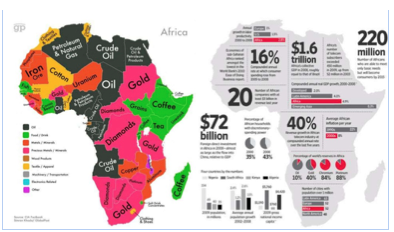
Africa's Wealth Prospects

According to Prof. Ezio Manzini, one of Europe’s most eminent social innovation experts, Africa is poised to leapfrog from a ‘not yet fully industrialised’ economy into a hybrid, multi-local society.

Manzini argues that if first world innovation is applied to valorize Africa’s third world commodity base, it will by-pass certain stages of economic development to reflect a new form of post-industrial society with a different economic structure.

The Leapfrog Hypothesis

A shift towards an advanced multi-local society in a not-yet (fully) industrialized society
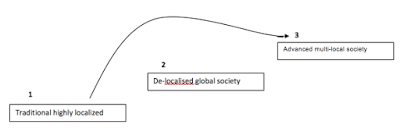
Leapfrog Hypothesis

According to Professor Philip Spies, one of Africa’s leading futurists, Africa’s leapfrog requires a supportive innovation environment to enable such a future economy. This would blend endemic (human-centered) technological innovation with ‘technology transfer’ (artefact-centered innovation) in a way that strengthens rather than disrupts a community’s potential for development.

Global investors like Unilever, are already adopting this strategy in Africa with a multi-local, rather than multinational approach to sustainability on the continent.  It is sourcing local products and using local people, embedding local values in the design and using first world technology to produce and distribute goods to market. In this way, technology transfer and diffusion of innovation has a far greater rate of success.

The structure of the Industrial economy in the developed world
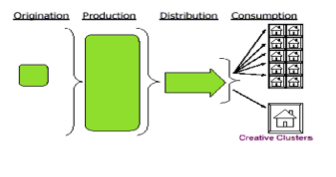
developed world

The structure of Africa’s post-industrialised, multi-local economy
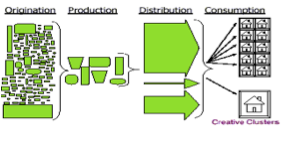
Africa post-industrialized, multi-local economy

There is growing awareness that while first world technology will boost Africa’s intelligence, ensure greater quality, reduce labour costs through mechanising replicable actions and enable better monitoring, in the developed world it produced a regenerative industrial culture and marginalised the poor.

Therefore a host of educational and policy initiatives are underway to drive Africa’s transition to an innovation-led economy with supportive socio-economic conditions. In 2014 the African Union adopted the Science, Technology and Innovation Strategy for Africa (STISA).

This continental strategic framework focuses on six critical areas for socio-economic innovation:

  • eradication of hunger and ensuring food & nutrition security;
  • disease prevention and control
  • and ensuring well-being;
  • communication,
  • live together- build the community and;
  • wealth creation.

The changing structure of global trade, international architecture of finance and technological innovation in banking will have a profound impact on wealth creation in Africa.

The International Monetary Fund (IMF) forecasts that in the next 10 years, six of the ten highest growing economies will be in Africa. Current FDI flows are around $60-billion a year boosted by the BRICS geo-political alignment encouraging greater trade with Brazil, Russia, India and China. The rate of return on foreign investment in Africa is higher than in any other developing region with almost three times the average multiple growth potential.

However, it is constrained by four major obstacles: a lack of access to formal financial services, weak infrastructure, a lack of funds for public investment and political instability in certain countries.

While agriculture and fishing accounts for two-thirds of jobs in Africa, they suffer the most from these obstacles. Currently, Africa is the least wealthy region with the lowest number of High Net Worth Individuals [HNWI] in the $52.5-trn global wealth system.

2013 Global Wealth by Region

Rank Region Overall Wealth

USD trillions

Annual

Change

No. of HNWI (millions) Annual

Change

Forecast Growth Rate
1. North America 14.8 16.6% 4.3-m 16.6% 3%
2. Asia Pacific 14.2 17.3% 3.02-m 25.8% 7%
3. Europe 12.3 12.5% 3.83-m 12.5% .2%
4. Latin America 7.7 3.1% 0.45-m 8.3 1.3%
5. Middle East 2.1 16% Under 1-m 7.1% 2.5%
6. Africa 1.34 3.7% 0.14 -m 13.2% 5.2%
Total 52.6-t 13.5- m Av: 3.2%

According to the CapGemini’s 2014 World Wealth Report, wealth it is led by North America [$14.8 -t], Asia Pacific [$14.2 -t], Europe [$12.3 -t], Latin America [$7,7 -t], the Middle East [$2,1 -t].

Africa’s HNWI

In 2014, Forbes’ annual ranking of the world’s richest people recorded 1,226 billionaires and 13.5-million HNWI. Of these, there were 16 African Ultra High Net Worth Individuals [UHNWI] who comprise a little over 1% of the positions on the Forbes list.

Of the 2-million HNWI who entered the rank last year with assets between $1-m – $5-m, Africa increased its share by 13.2% to 140,000 (0.14% of total).

Global HNWI Wealth is expected to reach $64.3-trn in 2016 and will continue growing at 6.9% a year across all regions, except Latin America. Asia-Pacific is set to overtake North America’s HNWI population and wealth by 2016 with a growth rate of 9.3%. Over the longer-term however, Asia’s tigers will be out-paced by Africa’s lions.

Growing Middle Class Consumers

Africa has the fastest growing middle class in the world comprising 313-m (34%) of its 1-billion population; a 100% rise in less than 20 years. Of this, 123-m are capable of spending $2.2 a day. By 2050, Africa’s middle class will grow to around 1 billion (42%) of its total population and represent 53.7% of the world’s consumers. They will require financial products and services to provide for rising needs in education, housing, transport, telecommunication, technology and protection of their household and business appliances.

The exponential and recursive impact of financing socially innovative technologies go beyond gains in intellectual property rights. Investments such as 3D printers in education, financing hybrid energy solutions for homes, re-fitting of fuel stations for electric vehicles and use of wearable devices in healthcare disrupts conventional ROI thinking and enables everyone in the value chain to play to their strengths.

Africa’s Middle Class Consumers
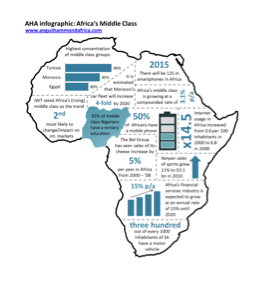
Africa's Middle Class Consumers

Youth demographics

The nature of the African market is distinctly different to Europe. Africa has a younger, more mobile market. Of the 1-billion people in Africa, 50 percent are under the age of 25. As children of ‘the unbanked’, they have very little education in financial services, lack a savings mindset and the majority are unemployed or work in primary and secondary industries. Of its adult population, two-thirds do not have a bank account or access to savings, credit or insurance. The disposable income required to consume such services includes costs for banking fees, transport, ICT infrastructure and electricity.

Innovative, Pan African financial products need to be designed to educate and cater for the continent’s youth, nomadic, migrant and refugee community. This is where Ecobank and M-Pesa are gaining a first mover advantage with technologies that enable users digital access to money, markets and products.

Says Judith Seekopp, a Swiss Banker and Wealth Manager, “Whereas the European market focuses on wealth preservation to cater for more mature, aging investors to secure generational wealth, Africa’s financial services products needs to have a stronger focus on wealth creation and tap unused wealth for start-up investments of young entrepreneurs on the continent.

Judith Seekopp

Judith Seekopp

 Digital Banking

The adoption of digital technology by wealth management firms in Africa has lagged behind the broader financial services industry. However, as digital connections ramp up among Africa’s youth, firms will have to adapt to provide integrated touchpoints which will enable stronger client relationships, reduce operating costs, enhance reporting systems and effectively deliver on its brand value proposition. The preference for digital contact in Africa is much greater compared to older clients in Europe.

According to the CapGenesis Global Wealth Report 2014, the global preference for digital is 26.4%, up from 23.7%; and is especially strong in Asia-Pacific (excl. Japan) at 37.8% and the Middle East and Africa at 33.5%. There is also an increasing preference for customized services (29.2% versus 26.0% a year earlier). This is especially strong in the emerging markets of the Middle East and Africa (48.2%), as well as Asia-Pacific (excl. Japan), at 36.7%.

Open Architecture

More investors are drawing on the expertise of local financial institutions than New York or Europe bankers to channel wealth into investments on the continent. In the past, wealth was primarily channeled offshore.

According to André Rangasamy of Wealth Planners, an investment advisory and financial planning firm to HNWI, there is increasing investor interest in Africa funds. “When constructing a global portfolio, the relatively low correlations between African equity returns and developed market returns make exposure to African equities particularly attractive. The ride may be bumpy, particularly over 1- 3 years, but this trend looks set to continue as the expected returns over the long term remain relatively attractive”.

To manage wealth across African countries, at various stages of economic development and socio-political systems, would require a Pan African approach to portfolio management with a wealth management network and open architecture product platforms. This would enable private banks to distribute products of other banks in exchange for a commission and not be restricted to selling only its proprietary products.

By using technology, wealth managers will better determine interests and contradictions quicker and develop more responsive strategies.

Says Judith, “Banks in Africa will attract more Euro-clients in the future as more HNWI invest on the continent. Open architecture systems will be needed. Also, they will require the proximity of a wealth manager on-site to enable access to tailor-made and traditional investment solutions at the level of quality, service and comfortability experienced by a UHNWI in Switzerland.

“The DNA structure of Swiss banking standards is the golden seal in wealth management globally. By blending South Africa’s technologically innovative banking system with world-class standards applied to socially responsible investments, new growth strategies can be unlocked. Quality, productivity and service delivery in wealth management are presently hampered in Africa without such innovation.”

Investment opportunities exist in infrastructure finance and corporate funding to facilitate Africa’s key growth sectors – agriculture, energy, finance, fishing, health, human capital, manufacturing, mining, technology, tourism and water. They present investors with early-stage investment opportunities.

To contribute to Africa’s leapfrog, innovative channels, products and services need to be designed that leverages its commodities, renewable energy and telecommunications systems for greater impact, sustainability and security.

Says Prof. Spies, “Such interventions, if well designed within a climate of social innovation, have recursive qualities to be the cause and the effect of transformative actions, thereby propelling a ‘snowball’ effect”. Eventually this momentum reaches a tipping point.

Extractable energy

Africa extractable energy resources (oil, natural gas, coal, and uranium) are worth between $13-14.5trn. In addition, there is around $762.4bn in net new money to be generated by untapped production potential in six key sectors – agriculture, water, fisheries, forestry, tourism and human capital. These provide scope for innovative investment products linked to IP (intellectual property) for institutional and private investors to benefit from exponential scaling using pricing models that are outcomes-driven.

Green comparative advantage

Renewable clean energy through wind, solar, hydro and biomass projects play a major role in sustaining Africa’s comparative advantage in the global green economy. With a 30 year history in solar innovation, it stands on par with the developed world. Mega projects are underway to develop solar and wind farms across the continent. This will enable Africa to increasingly delink economic growth from energy consumption and secure, clean energy supply to investment projects over the long term.

Philanthropy

The next generation of HNWI are ‘the millennials’ who have different social values. Those from the developed world will require guidance to manage significant inherited wealth and they will look for relationship managers who connect with their mindset. Currently, 75.0% of HNWI under 40 cite driving social impact as either extremely important or very important. However, the tendency declines about 10% with each age segment, reaching a low of 45.4% for those 60 and older.

Young HNWI recognize that one of the most serious threats to a sustainable world is global inequality in wealth and human competence. Today, some 85 percent of global wealth is owned by 10 percent of the global population. Empoverished people in Africa are caught in a low level human developmental trap largely because of their historical inability to profit from technological innovation.

Education and skills development in Africa therefore continues to strike a chord among HNWI who strive for social good. However, academic research proves that an innovative community cannot be ‘caused’ by developing skills or by more education. Rather, innovative societies emerge through cascading leadership and processes of infective social learning that lifts the confidence and status of members to apply, express and share their competence.

In the future, the inherent creative abilities of Africa’s youth needs to be tapped to encourage such endemic innovativeness. Using the paradigm of design thinking, the success of every-day problem-solving can be increased through this calculated, mapped out experiential learning process.

Technology and design innovation for sustainable tourism in Africa
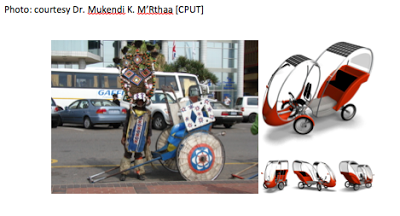
Technology and Design Innovation for Sustainable Tourism

Design is a bridge between creativity and innovation. It serves as a key source of differentiation, competitive advantage and value creation to drive economic growth.  Historically, Africans have been unable able to exercise their own transformative power to produce value and thereby, wealth through design. Real development in Africa will only occur when its people are able to satisfy their own legitimate needs and aspirations in a meaningful way.

Untold Wealth

It is interesting to note, that at Blombos Caves in the Western Cape, the world’s earliest archeological evidence of design can be found in stone artifacts, clay pots and shell work depicting a 100 000 year design heritage. These contain locked-up knowledge on Africa’s ancient design code. Just as Steve Jobs created the Applemac on the code of Zen design, real African innovation will source its principles on this deeper foundation.  Therefore, the master key to Africa’s future wealth is yet to be unearthed.

Blombos Caves: near Pinnacle Point in the Western Cape
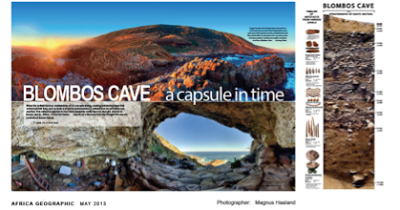
Blombos Cave

Since the scramble for its resources began in the mid-17th century, Africa’s precious metals have found their way to the balance sheets of colonial empires and its people dislocated from its philosophy of wealth.

In the 21st century, it is poised to grow faster than the rest of the world with a greater ability to take stock of and account for its wealth. The time is opportune to build a scalable private wealth management industry at the service standards of the developed world in a multi-local way.