IDDS Botswana 2018 Participants Selected!

We want to congratulate all the international participants who have been selected to participate in IDDS Botswana 2018.

These participants will be joined by 16 other local participants which includes 4 participants from each of the host villages and innovation centers of Dkar, Dutlwe, Rakops and Kaputura. These participants will work on 8 hands-on projects under the theme “IMPROVING RURAL COMMUNITY LIVELIHOODS IN BOTSWANA” from 15 July – 13 August 2018!

A very special thank you goes out to each of the reviewers who ensured each applicant was considered at a personal level, and to all the applicants who took the time to craft wonderful applications!

Follow link to learn more about our 2018 participants:

https://iddsbotswana2018.wordpress.com

To learn more about IDDS follow this link: www.idin.org/idds

IDIN Microgrant-Funded Social Enterprise Launches Unique International Development Social Media Platform That Doesn’t Require Internet Access

This article originally appeared on IDIN.org and can be found here.

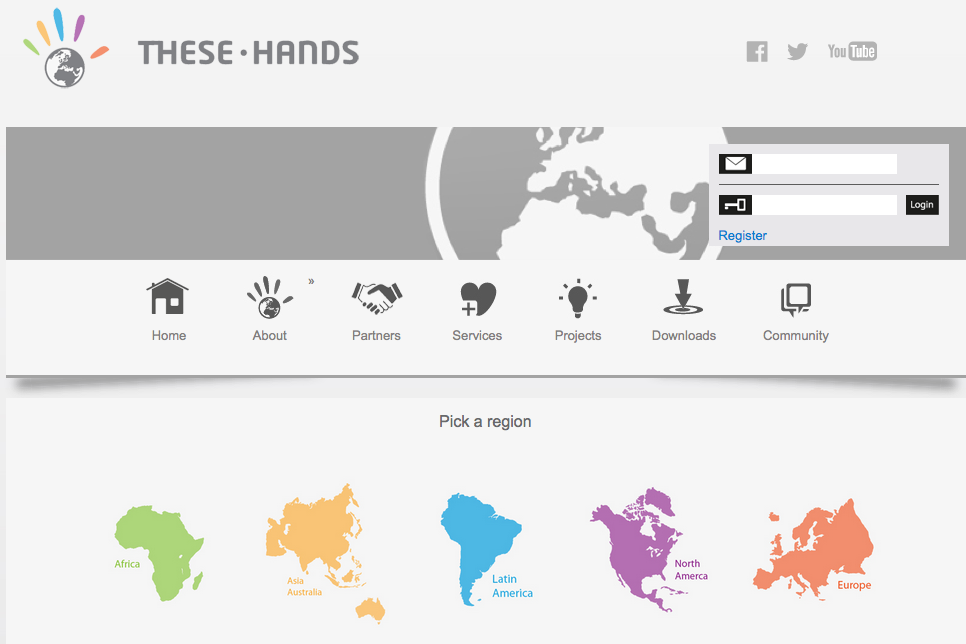
These Hands Social Network Home Page

Many developing countries have low levels of internet usage, often times resulting from a lack of internet infrastructure. However, in places where the internet is available it is often prohibitively expensive for the average person to use. Unfortunately, this has created a “digital divide” that has left these developing countries disconnected from the rest of the world. This has been particularly true for rural communities in developing countries who have the lowest rates of internet usage. The digital divide creates many problems for these communities as it keeps them underdeveloped. Many of these communities wish to lead their own development projects. However, their lack of connectivity leaves them unable to engage or continue with development experts to obtain technical and financial assistance for their projects. This lack of connectivity can also thwart attempts at entrepreneurship, which can greatly reduce poverty.

These Hands Global Social and Sustainable Enterprise is a for-profit social enterprise based in Botswana that is set on leading the fight to bridge the digital divide that many rural communities face. These Hands aims to combat the digital divide by creating a social network that will support community-led development in impoverished countries. It will do this by connecting local communities with the resources, business services, and mentors that they need to support their own development initiatives. This social network will also not require internet and can be accessed with a widely available 2G mobile phone, making it accessible to the vast majority of the developing world. This network will allow these communities to overcome the digital divide and take greater ownership of local development.

Having already contributed substantially to development projects in Botswana by hosting the 2015 International Development Design Summit in Botswana and by leading the way to establish the D’Kar Innovation Center, a proposed technology and enterprise development center that will serve the D’Kar community and other San communities. With the release of its social network, These Hands is primed to help start and support numerous development projects around the globe and ensure information access and continuity. The potential social impact of these projects is nearly limitless.

The challenge of ending poverty in the world is daunting. However, the world can confront this problem through a systemic approach that will have the creative industries being the main drivers to coming up with innovative solutions to our daily development challenges.

As we launch our These Hands social network, we invite you to register as member of the network, connect with others, discover and implement sustainable solutions to the world’s problems. Our greatest hope is that this endeavor will pave way to our successful journey towards the sustainable development of Botswana, Africa and the World.

For regular updates, find us on Facebook or visit our website to register for this new service!

Camp Fires & Star Gazing

A wonderful thing about having IDDS in the middle of the Kalahari Desert is that every night we get to witness a brilliant panorama of stars. With no air pollution or streetlights in sight, constellations are bountiful. The other day a family staying within the D’Kar community even invited us to use their telescope for a 2-hour star gazing session. We were able to see Saturn and its rings! We finished the night with an intellectual conversation and lecture on the history of constellations.

If we are not busy start-gazing in the evenings, we are eagerly sharing stories and laughing at the campfire. Being in the middle of the desert means that it is absolutely freezing in the evenings…fortunately, this encourages us to all congregate in one place, close to the fire. Thus far we have watched the process of charcoal making, heard traditional San stories, practiced West African dance, and even played board games together all while sitting around the camp fire. It is here that friendships are created and solidified.

IDDS Camp Fire

Part 5 – People-driven economic development in Botswana: innovation, entrepreneurial spirit and traditional knowledge

dkar

Between August 3rd and 16th 2015 the small San settlement of D’kar on the edge of the Kalahari Desert in western Botswana will be the venue of a unique and pioneering event: the International Development Design Summit D’kar 2015. In collaboration with the University of Botswana’s Department of Industrial Engineering, IDDS D’kar aims at connecting and training the San people along with selected participants from around Botswana and the globe in the basics of user-based technology design and business development process as they work together in diverse teams to co-create technologies that address particular local development challenges. The San communities in Botswana are some of the most creative people in Botswana with an immensely rich heritage of local knowledge and adaptive practices. However, they are also amongst the poorest and most marginalized people of the country.

For the Government of Botswana a big potential for economic development lies in the recognition and appreciation of the vast amount of (traditional) knowledge and practices of its people. It is the role of the state to encourage and reward entrepreneurship, innovation, technological advancement, scientific exploration and groundbreaking ideas that will contribute to further economic growth and social welfare of the country. IDDS D’kar hopes to inspire government, civil society and every citizen of Botswana with tangible dreams and concrete results in the form of innovative prototypes and ventures that improve people’s lives.

Botswana has since independence seen great economic growth but relatively little economic development. The general social welfare of Botswana is not matching the economic status of the country, the economy needs to be diversified in order for the economic development to be sustainable and citizens need to be encouraged and empowered to show more initiative and play a larger role in their own economic development and that of the nation as a whole.

The Government of Botswana has invested hope, energy and resources in the future of the country: the youth. Education and skills development have led to a more educated youth than ever before. However, the levels of unemployment amongst this large group of educated youth are currently high. This is not only a consequence of recent economic downturn; it could also indicate poor quality of education and poor preparation of graduates by the education system to be flexible, innovative and to show initiative and an entrepreneurial spirit. If the youth of the country can be inspired and stimulated to develop these attributes, there is a great potential for much needed growth of citizen economic empowerment and private sector expansion. The underlying principle for citizen economic empowerment in Botswana should be to promote social cohesion and harmony, to promote a notion of nationhood and pride and to maximize potential of human capital as well as to reduce both absolute and relative poverty. Meaningful citizen participation and initiative is essential to make this succeed.

Recognizing the urgent need for the diversification of the economic drivers of the nation, as well as the importance of the human capital in the development of the country, the Government of Botswana has identified the Cultural and Creative Industries as a key sector for economic development and growth. It is deemed essential for the development of the country to build on people’s individual creativity, skills and talent and to create the right environment for people to stimulate the use and development of these traits, especially through grassroots innovations and vocational skills application.

Through technological innovation, Africa has the potential to construct more wealth in the next 35 years, than it amassed in all of history. Rather than simply ‘copy-pasting’ knowledge, practices and technologies from western countries, a context specific approach which leaves space for using local products and using local people combined with the application of first world innovations and technological advancements can “leapfrog” African countries from the status of not-yet (fully) industrialized society towards an advanced and prosperous multi-local economy.

Huge potential lies in the fact that Africa has the largest growing middle class of the world, who will require socially innovative technological products and services to provide for rising needs in education, housing, transport, telecommunication, technology, finances, protection of their households and business appliances. The local context of a relatively young and more mobile market, cultural and historically different (and diverse across African states) customs concerning money, livelihoods, investment and entrepreneurship, as well as the potential benefits of extractable energy, potential for the use of sustainable green energy sources, and a changing mindset amongst the African (and international) youth and influential people directed towards the ‘social good’ are all factors to be considered when thinking about innovation and (social and economic) development of African countries such as Botswana.

Innovative societies emerge through cascading leadership and processes of infective social learning that lifts the confidence and status of members to apply, express and share their competence. Therefore, the inherent creative abilities of Botswana’s youth need to be tapped to encourage such endemic innovativeness. Design is a bridge between creativity and innovation. It serves as a key source of differentiation, competitive advantage and value creation to drive economic development. Driven by a human-centered design approach to technology innovation, the success of every day problem solving rooted in traditional knowledge and practices can be strengthened and applied.

An initiative such as IDDS D’kar, will plant the seeds that are needed to grow confidence and conviction among Botswana as a nation and the San community in particular that creative innovation rooted in a combination of traditional and modern technologies can contribute to development and social welfare of local communities. It will increase meaningful citizen participation and inspire innovativeness, creativity, autonomy and entrepreneurship as strong yet peaceful weapons to reduce poverty and increase social well-being.

It is therefore appropriate that the summit is themed KURU: a Naro word meaning TO DO or TO CREATE.

Part 2: Youth, Education, Development – What are the gaps and prospects for the future?

Botswana Children

In his 2012 state of the nation address the President mentioned with regards to youth empowerment that our nation faces no greater task than that of empowering our youth to achieve their aspirations for a productive and meaningful life. Census findings reveal that some 39% of Botswana are aged between 15 and 35. Yet notwithstanding the fact that this age cohort is better educated than any generation before them, or that many of them also possess additional life skills and talents, such as relatively high levels of ICT literacy, as a group they are struggling. Having come of age in an especially challenging time of economic downturn, our youth deserve the government’s special support. The nation’s present opportunities as well as future prospects are at stake. With their energy and innovative capacity our youth are solid assets, who need to be enabled if we are to be a more prosperous and productive nation.

He further went on to mention that government’s commitment to building a better future by investing in our youth is perhaps best reflected in their devotion of substantial resources to their education, training and overall skills development, both in and outside the classroom; they recognize that our education system must be adapted to meet evolving social and economic demands. Statistics show that participation in tertiary education has been increasing steadily over the years but is still relatively low. About 45% of the relevant school‐leaving age group is entering tertiary education and about 64% of them are going to private institutions.

The levels of unemployment for the educated are high with tertiary level graduates comprising 15% of the unemployed and those with post‐secondary certificates a further 22%. These figures suggest poor quality of post‐school education and/or an inability of the economy to absorb individuals with high levels of education or maybe even lack of intuition, innovation and initiative by the graduates of the education system. This could be caused by other non-economic factors such as a dependency culture which was brewed by government’s active role in assuming the private sector role since 1976.

The need for the adaption of the education system is the principal justification for the development of Botswana’s first comprehensive Human Resource Development Strategy set to be realized by 2029. When it is implemented it will provide a strategic link across each of the vision 2016 pillars, and a vital underpinning to the range of government, societal, sector and institutional reforms that are necessary for Botswana to achieve the status of “winning nation”.

So far through the Human Resource Development Council, several sector committees have been setup to review and develop integrated HRD plans in line with this strategy. As an identified key alternative driver of societal development, economic development and growth, the government has through its Ministry of Trade and Industry’s Economic Diversification Drive (EDD) placed the creative industries as the number one priority sector to development in line with the Private Sector Development Strategy and Human Resource Development Strategy.

It is argued that a human resource development strategy that recognizes the creative industries as key cross cutting catalysts or a sector for Botswana, will ensure that the policies of government, the desires of civil society, the programs of educational institutions, and the initiatives of business and industry are better aligned and work together in a coordinated way to enhance overall sustainable human resource capabilities and consequent economic growth and development. In the next blog post I will discuss some theories on the cultural and creative industries and how these can contribute to economic development of the country and its people.

Posted 7th June 2015 by

Part 1: The Value of Cultural and Creative Industries for Botswana and Africa: Taking a Human-centered approach to Development – What can we learn from Botswana?

As we prepare to host IDDS D’Kar 2015 in Botswana, it is useful to present a local perspective on what development might mean in an African context and how the value of indigenous knowledge in design might open up new pathways of understanding for our participants.

This is the first post of a 5-part blog series in which I will share some insights into key themes in Botswana around the role of the state, human capital, creativity, wealth creation and historical challenges to development. As Co-founder & CEO of These Hands GSSE and ardent Creative Economy Advocate in Botswana, I will frame 5 pertinent questions for reflection:

  • Taking a human-centered approach to development: What can we learn from Botswana?
  • Youth, Education, Development: what are the gaps and prospects for the future?
  • How can design help Botswana’s cultural and creative industries drive economic development?
  • Botswana in the context of Africa’s future wealth potential – How can design help Botswana leap-frog to a multi-local society?
  • Can Africa strike the right balance in the 21st century? Profit AND People-driven development – can we think either/and?
      • This last blog post could also be a short summary of main arguments, linking my work to Merle’s perspectives as well as the potential contribution of IDDS D’kar.

My contribution is supported by Merle O’Brien (@merleobrien), a South African futurist and participant of IDDS D’kar 2015 based at Creation iLab (www.creationilab.com) where she specializes in creativity, design and innovation through indigenous knowledge. She shares her insights on Africa’s potential to amass more wealth in the next 35 years than in all its history. The biggest opportunity here is for design to influence the global value chain of future African innovations – from concept, the design prototype, sourcing raw materials, embedding creative and quality standards of suppliers, the marketing, logistical distribution, retail experiences and service support to the end user. In this way, economies such as Botswana could leapfrog from an agro-industrial economy to a multi-local society driven by a human-centered design approach to technology innovation. It is against this backdrop that the value of IDDS D’Kar 2015 becomes more significant as we begin to recognize the relevance of our design approach at this point in time, in Africa.

The world’s earliest evidence of design can be found in Southern Africa. The stone artefacts, ochre paint pots, beaded shells and weapons found in Blombos Caves in the Western Cape date 100 000 years back. These archeological findings reflect how the earliest humans conceived ways to survive, communicate, express meaning and evolve new ways of doing, thinking, eating, hunting and playing.

It is a paradox that the continent with the world’s oldest design heritage is currently the poorest, yet set to grow faster than any other in the first half of the 21st century alongside the value of design. It is also humbling to know that the San communities in Botswana have a deep design heritage locked up beneath the foundations of modern thinking. It is as if, through D’Kar, we might return to source to unearth the old, to help us make better sense of the new. It is therefore appropriate that the summit is themed KURU: a Naro word meaning TO DO or TO CREATE.

Blog 1: Taking a Human-centered approach to Development – What can we learn from Botswana?

Before World War II most world states were largely interested in economic growth as the only measure of economic development. After the World War II, prior and during the decolonization of most African states, there was a looming ideology of communism which was quite opposite to the capitalistic view in that it introduced a social welfare or basic needs approach to the realm of economic development. In the 1990’s most countries were undergoing a choice process of either aligning with absolute profit driven economic growth policies for economic development or go with the other absolute social welfare development principles of economic development.

Post the cold war the Millennium Development Goals (MDGs) which were introduced by the United Nations Development Programme came into play to strike a balance between the two extremes and find synergies. This created space for the interlinked principles of development economics and managerial economics which signal out clearly the role of the state in economic development.

The principles of managerial economics teach us that it exists to ensure that firms and households at micro level are willing and able to produce maximum output which shall ensure maximum profits and maximum satisfaction as the per the demands of the households respectively.

At a macro level the understanding based on the principles of development economics, teach us that it exists to ensure that governments are willing and able to ensure viable industrial growth which will in turn ensure economic growth and maximize social welfare of the households.

The role of economic profit is therefore a very important one, as government depends on profits from firms to ensure economic growth and maximize social welfare. When firms make profits they are willing and able to create employment as they expand, which satisfies the welfare aspect of the government agenda.

These profits of the many firms and that of some that may mushroom from the employment created, result in aggregated tax revenue which satisfies the economic growth agenda as embedded in the principles of development economics. Some of the tax revenue is used to create a harmonious environment to grow the industries and also combat other welfare needs like health care and education (Todaro, M, et al 2006)

The economic profit further satisfies the society’s development through sponsorships and donations that are made by the firms to community based organizations, non-governmental organizations, social enterprises and community trusts as it assists the government agenda of maximizing social welfare and improving wellness.

The role of the State, in an open economy like Botswana, is to ensure sound, informed and sustainable laws and policies in order to ensure a harmonious working environment for industrial growth and job creation which will consequently satisfy the government agenda of having maximum economic growth and social welfare.

The following are some of the elaborate micro and macro level benefits of economic profit that a good state that satisfies its role diligently can ascertain:

  •  Rewards and encourages initiative, hard work and risk-taking.
  •  Encourages innovation, progress, improvements, efficiency, and technological advancement.
  • Encourages scientific exploration and Research and Development to discover new innovations and advancements.
  • Encourages new suppliers/businesses to enter the marketplace, thereby creating more competition and diversity of goods and services.
  • Provides people with a vast array of goods and services that they want and need.
  • Lowers prices and makes goods and services more affordable.
  • Creates jobs for citizens and opportunity for immigrants.
  • Attracts investment by rewarding banks and individuals that invest in companies and entrepreneurs.
  • Creates new capital (retained earnings) that can be used for economic growth and to provide insurance in times of recession.
  • Creates wealth and capital for charities, the arts, and good works.

Botswana has since independence experienced great economic growth with the Gross Domestic Product per capita and Purchasing Power Parity (US dollar) in Botswana being last recorded at 4377.56 US dollars and at 14752.70 in 2011 respectively. The GDP per Capita in Botswana is equivalent to 35 percent of the world’s average. However, the social welfare of its people seems not to be matching these positive developments. Based on a comparative measure of life expectancy, literacy, education, and standards of living for countries worldwide, Botswana has a Human Development Index of 0.633 and is ranked 98th in the world signifying medium human development for a country of its economic status.

Economic Development exists when a country compared to other comparable countries in the region (Sub Saharan Africa), has managed to grow the economy away from primary industry dependency to one that will be driven by secondary and tertiary industries.

Botswana is performing poorly in economic development as it is still largely dependent on the primary industries of mining and agriculture as her main contributors to economic growth and has failed to develop the secondary and tertiary industries. Moreover, job creation in the private sector is insufficient and to date the government is still the largest employer. The costs of production for the private companies are still too high and they do not have the necessary markets locally and regionally and thus cannot make the necessary profits to create jobs.

Botswana’s National Development Plan goals which are pegged and closely driven by the pillars of her Vision 2016 are to ensure economic growth, reduce poverty and create employment. We can point out that so far Botswana has managed to succeed on the economic growth goal but has failed on the other two based on the 35% unemployment rate of the youth and the relatively low Human Development Index.

Acknowledging these gaps, the government of Botswana is trying to address them with initiatives like the private sector development strategy in partnership with the voice of business being the Botswana Confederation of Commerce, Industry and Manpower (BOCCIM), a youth in business High Level Consultative Council (HLCC) Sector committee that meets with the Minister of Youth, Sports and Culture twice every quarter to advice on high level red tapes that hinder industrial growth or opportunities for youth owned businesses, the youth development fund, Citizen Entrepreneurial Development Agency (CEDA), a Local Enterprising Authority (LEA), a revived department of cooperatives under the Ministry of Trade and Industry, The Botswana Innovation Hub, Botswana Institute of Technology, Research and Innovation and the National Human Resource Development Strategy which is headed by the Human Resource Development Council to mention a few that have been setup to stimulate this diversification drive.

Through successive development plans since NDP7, the importance of developing Botswana’s human resource capacity has been a first line priority. From a broad range of perspectives such as educational attainment, skills and training, quality of life issues, and the expansion of the labor market, considerable progress has been made. However, a lot still needs to be done to have an educated and informed nation that will actively participate in the economic development of the country. In the next blog post I will present my insights into the themes of youth and education and how they relate to the development of Botswana. I will discuss some of the gaps and strategy’s that the government has initiated to address these, as well as prospects for the future.

Meet the Authors:


Merle O'Brien South Africa

Merle is a design futurist at Creation iLab, a start-up transmedia and design innovation lab which serves as a testbed for her doctoral research. She holds a MPhil Future Studies from the University of Stellenbosch Business School, specialising in the future of creativity. She is exploring how the fields of art and science are moving towards a common space and the radical innovation this holds for the confluence of creative lifescience, technology and indigenous knowledge to alter the axis of Africa’s future in sustainable and positive ways.

Thabiso Mashaba Botswana

Thabiso Blak Mashaba (@BlakMashaba), Lead Organiser of IDDS D’Kar 2015